
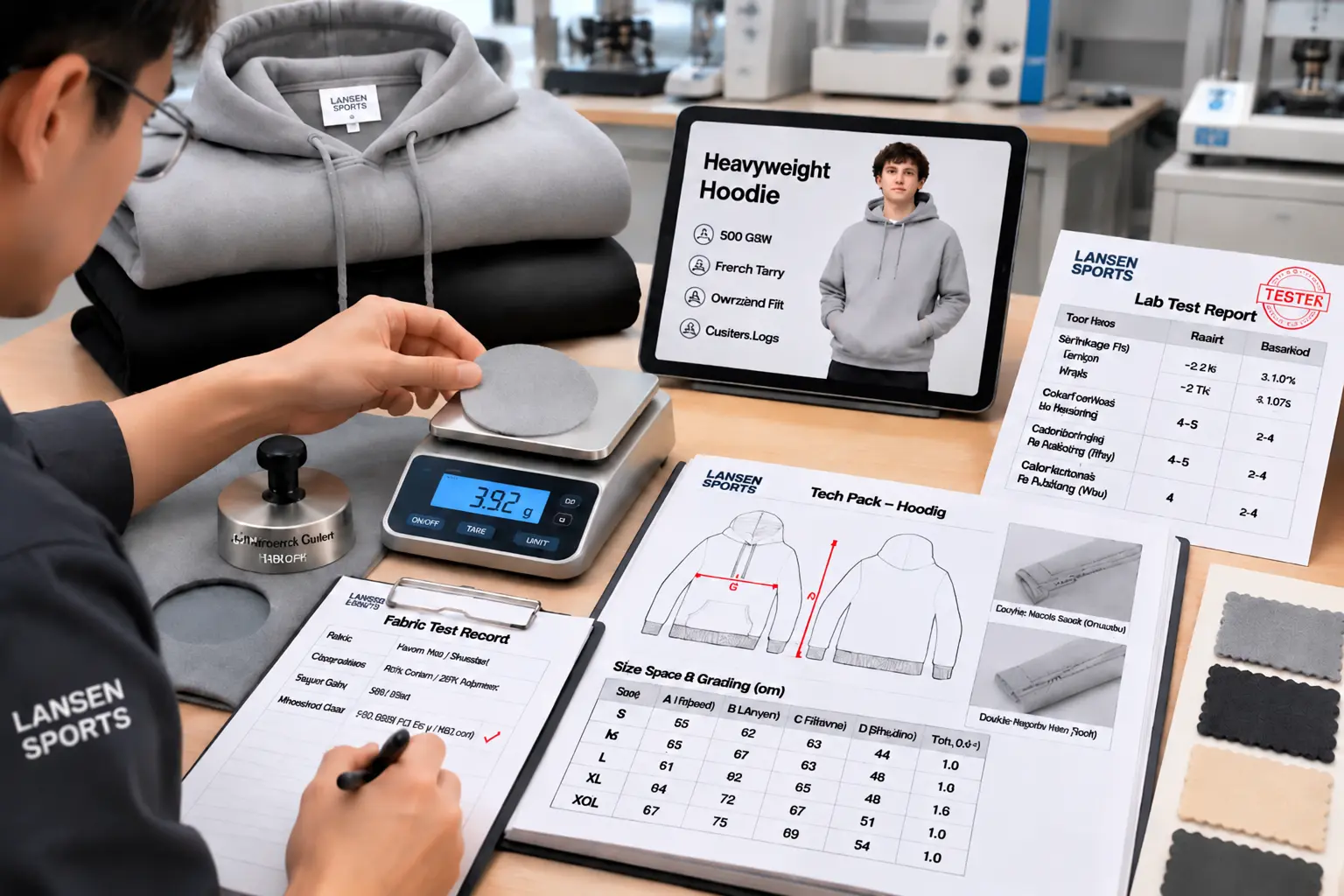
In custom apparel manufacturing, marketing claims and actual production specifications are easily confused. An overseas catalog might showcase an ultra-luxurious photograph alongside promises like "heavyweight 500 GSM fleece," "zero-shrinkage guaranteed," or "commercial-grade colorfastness."
However, a stylized photo demonstrates aesthetic concept—not an engineering specification. Similarly, a factory spec sheet outlines target dimensions, but it does not guarantee real-world garment durability after washing and wear.
For streetwear brands, DTC founders, and private-label buyers sourcing custom hoodies, sweatpants, and T-shirts, learning to audit supplier claims against documented lab testing is vital. Here is a practical framework to separate visual marketing from verified production data before issuing a purchase order.
Classify the Claim: Photos vs. Tech Specs vs. Performance Guarantees
Every piece of product information provided by a manufacturing partner belongs to one of three distinct categories. Blending these categories creates costly sampling cycles and misaligned production runs:
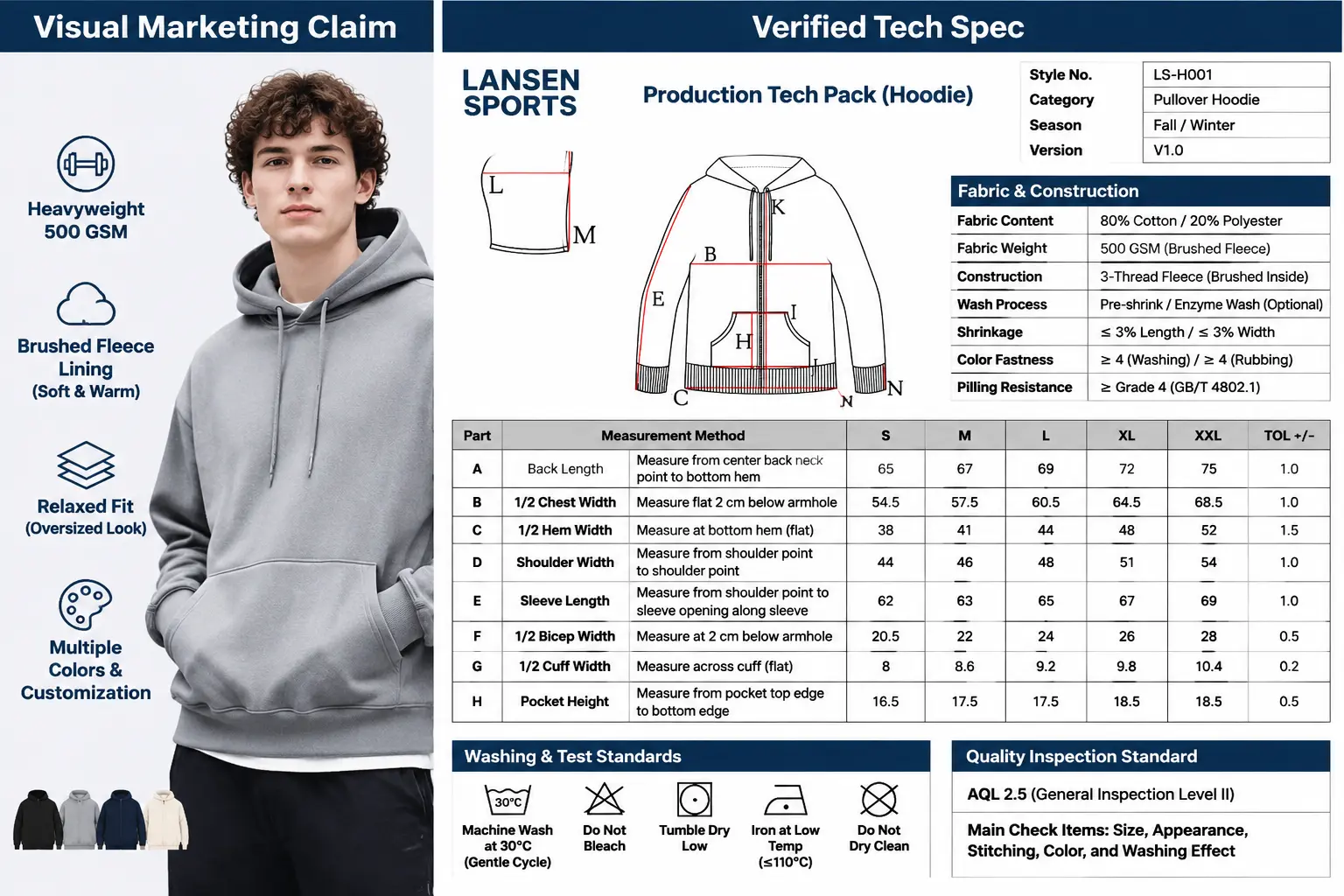
Visual Marketing Assets: Lookbook imagery, styled flat-lays, and 3D mockups demonstrate silhouette drape, color aesthetics, and concept styling. They provide zero verifiable data on yarn count, fabric density, or seam burst strength.
Technical Specifications: A technical data sheet documents physical inputs: fabric composition (e.g., 100% combed ringspun cotton), knit structure (e.g., 3-end fleece), target fabric weight (GSM), and stitch density (stitches per inch). These numbers define the blueprint, not the finished garment's behavior after washing.
Verified Performance Outcomes: Measurable claims—such as dimensional stability (shrinkage under 3%), colorfastness to washing (Grade 4.5), or anti-pilling ratings—require standardized laboratory test reports (such as ISO or AATCC testing methods) conducted on the finished, treated garment.
Before integrating supplier claims into your public marketing or retail copy, confirm which category the information occupies. If a factory presents an aesthetic sample photograph, request the corresponding physical specification before making sourcing decisions.
Match the Evidence to the Specific Production Batch
A common trap in B2B apparel procurement is accepting historic test reports as proof of current batch quality. A material mill test report or eco-certification from a previous production run provides helpful background context, but it does not certify your custom order.
When evaluating supplier evidence, audit the following details:
Style & Material Code Alignment: Verify that the fabric code on the test certificate matches the exact raw yardage reserved for your order, rather than a different fabric line produced by the same knitting mill.
Development State vs. Bulk Output: During initial prototyping, treat all supplier claims as development targets to test rather than confirmed standards. Physical validation occurs during pre-production (PP) sampling.
Finishing & Dyeing Differences: If a test report covers a natural unbleached fleece, it cannot serve as evidence for a reactive-dyed jet-black fabric, as heavy dyeing and wash cycles alter fiber tensile strength and weight.
To maintain structured control over your technical requirements before ordering fabric, review our apparel product brief checklist to align material targets with your factory prior to sample development.
Audit Critical Fabric Metrics: GSM, Shrinkage, and Colorfastness
Do not copy numbers directly from a supplier catalog into your tech pack without understanding how those metrics were gathered. Three critical metrics require specific verification:
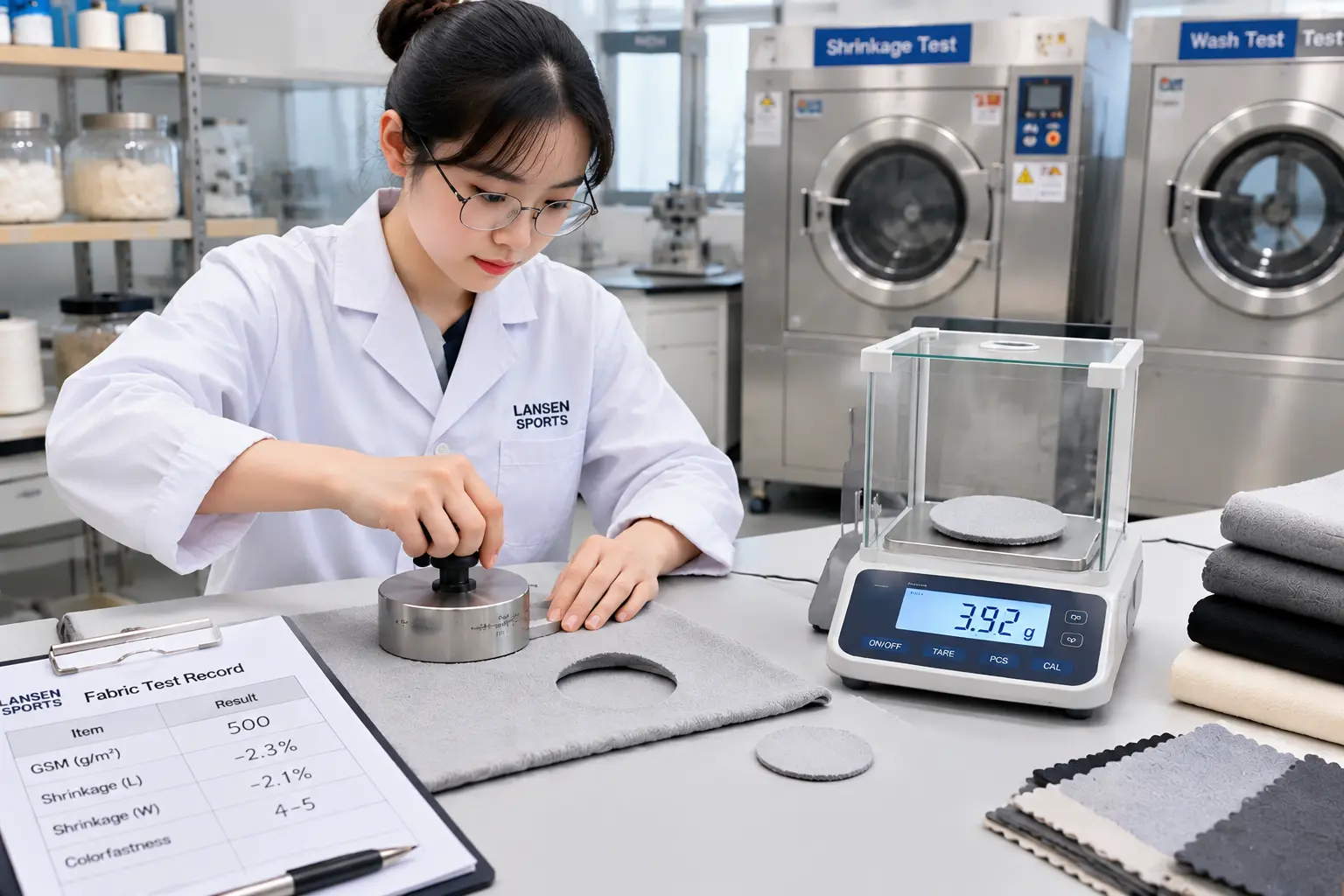
Fabric Weight (GSM Verification): Fabric weight should always be measured using a calibrated circular sample cutter and precision digital scale under standard humidity conditions. Suppliers citing nominal fabric weights often reference "greige fabric" before dyeing, which can lose or gain weight during final finishing.
Dimensional Stability (Shrinkage Testing): Avoid vague "pre-shrunk" promises. Request the specific test method used (such as AATCC 135 or ISO 6330 across 3 home launderings). High-grade custom hoodies should maintain length and width shrinkage within 3% to 5%.
Colorfastness & Rubbing Resistance: For dark shades and streetwear staples, request dry and wet crocking test ratings. A rating of Grade 4 or higher ensures your garments will not bleed onto white undergarments or light-colored furniture.
Build a Centralized Product Claim Register
For growing apparel brands, maintaining alignment between design, procurement, and e-commerce marketing requires strict version control. A simple, structured claim register prevents catalog notes from turning into unsupported public promises:
Exact Performance Statement: Record the precise marketing claim (e.g., "Heavyweight 450 GSM, Anti-Pilling Grade 4").
Internal SKU & Tech Pack Version: Link the claim directly to your current style ID and pattern release.
Supporting Verification File: Attach the physical lab report, third-party inspection sign-off, or textile mill guarantee.
Responsible Sourcing Lead & Date: Note the project engineer who verified the data and the validation timestamp.
Retesting Triggers: Revisit the claim whenever you introduce a new yarn lot, switch from stock fabric to custom vat dyeing, or modify finishing treatments.
Reviewing a partner's complete scope is vital. Discover how our OEM & ODM apparel development services integrate lab testing, precision grading, and standardized inspection into every stage of garment manufacturing.
Real-World Case: Why Changing Colorways Invalidates Fabric Specs
Consider a standard development scenario: a streetwear brand develops an oversized pullover hoodie in a Heather Grey colorway, verified at 420 GSM with a 3% shrinkage rate.
If the brand decides to release the same hoodie in Vintage Washed Black, the original specification data no longer applies:
Dyeing & Stripping Impact: Dark reactive dyeing and subsequent enzyme or acid wash distressing break down cotton surface fibers, directly affecting fabric tensile strength and final weight.
Thermal Shrinkage Changes: Dark dye baths run at elevated temperatures, which can compact or stretch knit loops differently than melange grey yarns.
Yarn Composition Differences: Heather grey fabrics frequently incorporate a small percentage of polyester to achieve the heathered visual effect, whereas deep blacks are typically knit from 100% pure cotton, changing the recovery and stretch properties entirely.
When altering colors, washes, or embellishments on core styles like hoodies and sweatshirts or sweatpants and joggers, always re-verify your material specifications rather than assuming performance carries over automatically.
Frequently Asked Questions (FAQ)
How can I verify fabric GSM without sending samples to an expensive commercial lab?
You can verify GSM in-house by investing in a standard circular fabric GSM cutter (which punches a precise 100 cm² disc) and a digital pocket scale reading to 0.01 grams. Weigh the circular swatch and multiply the grams by 100 to determine the exact GSM.
Can an apparel brand legally use a supplier's OEKO-TEX or GOTS certificate in marketing?
Only if the certificate covers the specific fabric lot, mill license number, and transaction certificate (TC) tied directly to your purchase order. Using a general factory certificate for goods cut from uncertified secondary stock creates legal and compliance liabilities for US and EU retailers.
Why do proto samples often feel heavier and softer than bulk production orders?
Proto samples are often cut from premium sample-room fabric yardage or small-batch custom knit rolls that receive dedicated finishing attention. Bulk yardage processed through commercial dye vats requires tight quality oversight to replicate the exact hand-feel and weight of approved fit samples.
Ready to Build Your Apparel Line with Verified Quality?
Stop relying on ambiguous catalog descriptions. Build your brand with an engineering-focused apparel partner committed to verifiable manufacturing standards and full transparency.
Physical Spec Auditing: Send us your tech packs or competitor benchmark garments for independent fabric weight, stitch tension, and construction analysis.
Complete One-Stop Development: From yarn selection, custom reactive dyeing, and pattern grading to rigorous pre-shipment inspections and door-to-door delivery.
Direct Manufacturing Capabilities: Explore our specialized manufacturing across custom hoodies, fleece sweatpants, and premium tees.
👉 Submit Your Garment Brief or Request an Engineering Review
Visiting China for the Canton Fair Recently? Let’s Connect in Person!
If you are currently traveling in China or recently attending the Canton Fair, we welcome the opportunity to meet your sourcing team face-to-face:
Executive Strategy Sessions: Visit our corporate headquarters in Shenzhen to review fabric swatch libraries, discuss custom tech packs, and plan seasonal production timelines.
Direct Factory Tours: Tour our primary manufacturing facility in Zhongshan to inspect our automated cutting equipment, knitting and sewing lines, specialized print facilities, and internal quality testing stations firsthand.

👉 Book a Meeting or Schedule a Factory Tour with Our Specialists