

Define the purpose of the review pack first
A useful review pack is not a catalogue and it does not need to pretend every project decision is complete. Its job is to help people enter the same development discussion with the same starting context. Begin by writing the purpose of the conversation in one sentence: perhaps the team wants to clarify the intended use, compare two directions, prepare for an early sample, or decide what information is still missing. This sentence gives every later page a role and prevents a collection of files from becoming an unstructured list of requests.
Keep the scope proportionate to what is actually known. A project can have a clear use case and a few visual references while material details, commercial terms, or a final construction choice remain open. That is normal at an early stage. The existing product brief checklist is a helpful way to distinguish the context already decided from the questions that should be explored. A review pack should make that distinction visible instead of turning an assumption into a final product statement.
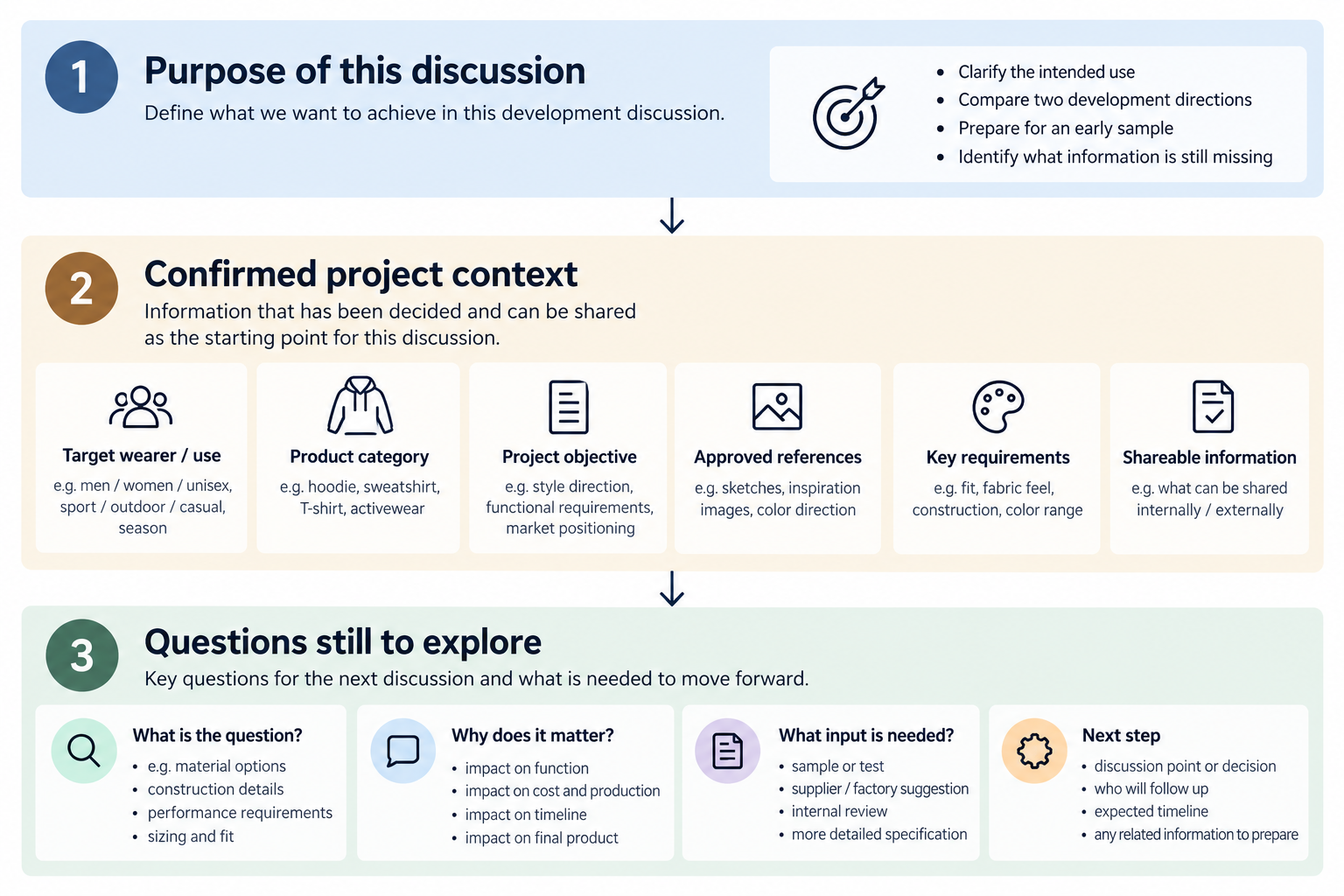
Organise a review pack around purpose, confirmed context, and questions for the next discussion.
Separate confirmed context from working inputs
Use two simple sections in the pack. The first holds confirmed project context: the intended wearer or use, the product category, any approved project objective, and information the team is permitted to share. The second holds working inputs: sketches, reference images, notes from a previous review, and questions for the next conversation. Label working inputs clearly so a reader does not mistake them for final specifications. This matters when the pack moves between people who did not take part in the first discussion.
References are often helpful, but they need a short source and permissions note. A photo or design can explain a mood, shape, placement, or question without becoming an instruction to copy it. If a reference does not have a clear public-use status, describe the characteristic in words and keep the asset for internal review. The same rule applies to notes copied from a product card or another source: a field may prompt a question, but it is not evidence for a public claim.
Turn open questions into a review sequence
Open questions are easier to handle when they are ordered by the decision they support. Start with questions about intended use and product direction, then list the points a first sample or later review should clarify. For each question, record why it matters, what evidence or input is still needed, and whether the outcome is a discussion point or a decision. This keeps the review focused on the next practical step instead of asking every contributor to resolve unrelated issues at once.
The process can remain useful without promising any commercial outcome. Avoid placing unverified price, MOQ, availability, lead time, certification, performance, factory, or customer-result statements in a general review pack. Those need their own current evidence and authorised wording. A focused OEM and ODM development discussion can instead use the pack to identify what the buyer wants to explore and which information should be checked separately. That protects the clarity of the development work while keeping claims within the evidence available.
Make comments traceable for the next handoff
A review pack becomes more valuable after the meeting if comments are recorded in a consistent way. For each point, note the item being discussed, the observation, the question or decision, the owner of the next check, and the status. A short dated log is usually better than a long narrative because it lets someone joining later see what changed and what remains unresolved. Keep personal opinions as opinions, and do not relabel them as confirmed project facts until the responsible people have agreed.
Before circulating the pack, remove material that is not needed for the next review and check that each remaining file can be shared. The goal is not to create a larger attachment; it is to create enough shared context for a useful response. This also helps prevent a reference, draft note, or third-party visual from appearing to be an approved public asset. The resulting handoff gives the next participant a clear place to begin and a clear list of what still needs confirmation.
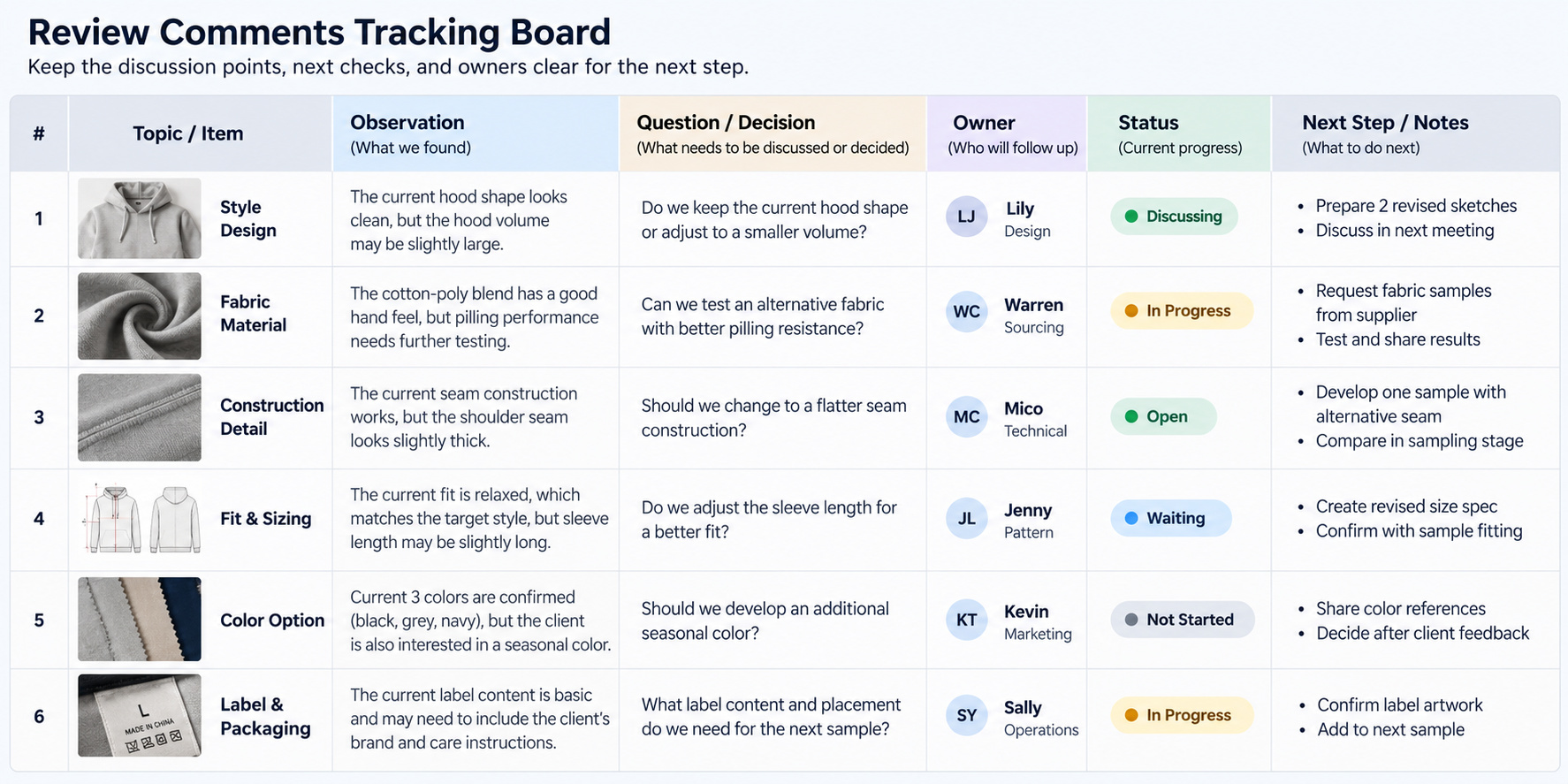
A short handoff record connects an observation, the next check, and a clear owner.
Close with a concise request for the next discussion
End the pack with a short recap that a recipient can act on. State the intended use, the main direction being explored, the questions that need attention, and the specific response or review you are asking for next. If a decision depends on information not yet available, say so plainly. This allows a discussion to progress without implying that the project already has settled specifications, approved performance, or final commercial terms.
A clear request also makes it easier to decide whether the next step is another internal review, a more detailed brief, or a development conversation. Keep the contact point focused on the project context and unresolved questions rather than attempting to make a broad promise. When the same pack is used as a living record, the team can update it as decisions are confirmed and keep earlier questions visible as historical context instead of losing the reasoning behind them.
Next step for your project
If you have a concise review pack with an intended use, approved project context, shareable references, and clear questions for the next step, use it to start a focused project discussion. Keep unconfirmed specifications and commercial terms marked for separate review.
Whether you are preparing ahead of the Canton Fair season or looking for a reliable manufacturing partner, our team is ready to connect. As a direct apparel manufacturer with our corporate headquarters in Shenzhen and our production base in Zhongshan, we welcome international brand partners to visit our factory and discuss your upcoming hoodie or activewear projects in person.
DISCUSS YOUR PROJECT
Visiting China or attending the Canton Fair?
Bring your project brief, sketches, or reference samples. Meet our product development team in Shenzhen, or tour our direct-to-source factory floors in Zhongshan to see our production capacity firsthand.